
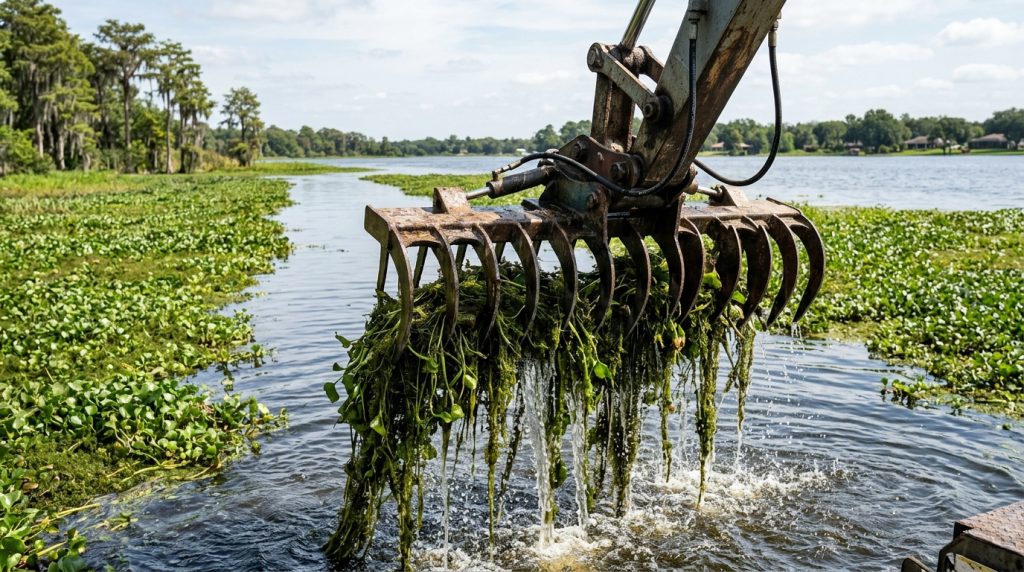
Every summer we get the same call from folks along the St. Johns and the smaller lakes around Seminole County. The weeds have taken the swim area again, the boat won’t clear the slip without dragging green ropes off the prop, and the dock smells like something died underneath it. At Florida Land and Lake, we’ve pulled hydrilla, cut back cattails, and cleared water hyacinth off enough Sanford shorelines to know that the first decision you make matters most: do you cut the weeds out mechanically, or do you treat them with herbicide? Both work. They work differently, they cost differently, and they leave your lake in very different shape a month later.
This post walks through both approaches plainly, so you can tell which one fits your water, your budget, and how fast you want the shoreline back.
What mechanical cutting actually does
Mechanical cutting means physically removing the plant. We cut it, rake it, and haul it out of the water so it’s gone that same day. No waiting, no die off period, no decomposing mat sinking to the bottom. You look out the window and the swim lane is clear.
For thick submerged growth like hydrilla, or floating mats of water hyacinth and water lettuce, cutting gives you an immediate result. That’s the biggest reason people around Lake Monroe and Lake Jesup pick it. A family with kids who want the water back by the weekend doesn’t want to wait ten days for chemicals to work through a plant.
The trade off is that cutting alone doesn’t always kill the root system. Some plants regrow from fragments left behind, which is why the removal has to be thorough and why the cut material has to leave the property instead of drifting back onto your shore. Done right, cutting also pulls out the organic load that would otherwise rot and feed the next bloom.
Our aquatic vegetation removal services are built around getting the plant material off site cleanly, so you’re not trading a weed problem for a smell problem a week later.
What herbicide treatment actually does
Herbicide kills the plant in place and lets it break down in the water. There’s no hauling on the day of treatment. A licensed applicator sprays or injects the product, the plant browns out over a week or two, and it slowly sinks and decomposes.
The appeal is reach. Chemical treatment can hit a large, spread out infestation faster than a crew with cutting equipment can physically clear it. For certain species that regrow aggressively from fragments, a targeted treatment can knock back the whole stand at once, including growth that a cutter would struggle to reach in deeper pockets.
There are catches worth understanding before you go this route. Killed vegetation doesn’t disappear, it sinks. On a lake that’s already dealing with a soft, mucky bottom, dumping a fresh load of dead plant matter can make that layer worse over time. There’s also a die off window where the water can look and smell rough while everything decomposes. And oxygen levels can dip as plants break down, which is hard on fish if a big area is treated at once during our hot Sanford summers.
How the two compare on the things you actually care about
Most people aren’t choosing based on the chemistry. They’re choosing based on how fast, how clean, how much, and what happens to their lake bottom afterward. Here’s the honest breakdown.
- Speed of visible result: cutting clears the area the same day, herbicide takes one to three weeks to brown out.
- What happens to the plant: cutting hauls it away, herbicide leaves it to sink and decompose in the water.
- Effect on lake bottom: cutting reduces the organic load, herbicide can add to muck buildup over repeated treatments.
- Coverage of large areas: herbicide can reach spread out growth faster, cutting is precise but slower over big acreage.
- Impact during hot weather: herbicide die off can lower oxygen in summer, cutting does not.
- Frequency: both may need repeating, since Florida growth is relentless from spring through fall.
Neither one is a permanent fix on its own. Our growing season here runs long, and warm water plus nutrient runoff after summer storms means weeds come back. The question is which method gets you the result you want with the fewest downsides for your particular shoreline.
Why the lake bottom decides more than people think
The single biggest reason we lean toward mechanical removal on a lot of Sanford properties is what’s already sitting on the bottom. Many of these lakes have years of accumulated muck, and every stand of weeds you kill in place adds to it. Once that soft layer gets deep enough, it becomes its own problem: it swallows your feet at the swim area, it feeds algae, and it keeps the weeds coming back no matter how many times you treat the surface.
If your bottom is already soft and dark and you can sink to your knees walking out, herbicide alone tends to make the underlying issue worse while it fixes the visible one.
That’s where our muck removal and lake bottom restoration work comes in, because clearing the weeds and then dealing with the sludge underneath is what actually gives you a firm, usable bottom instead of a temporary clearing that fills back in.
When cutting is the better call
Cutting wins in a few clear situations. If you’ve got a defined swim area or a boat lane you need clear right now, physical removal gets you there without a waiting period. If your lake bottom is already muck heavy, cutting avoids piling more dead material onto it. And if you’ve got kids, dogs, or livestock using the water regularly, hauling the plant out sidesteps the die off window entirely.
We also favor cutting near docks and beachheads where you want a clean, defined edge. It gives you control over exactly what stays and what goes, instead of browning out a whole zone and hoping it settles evenly.
When herbicide makes more sense
There are cases where a licensed chemical treatment is the practical answer. A large, spread out infestation across acres of shoreline can be more than a cutting crew can clear in a reasonable window, and a targeted treatment can knock it back faster. Species that regrow hard from fragments sometimes respond better to a treatment that reaches the whole plant.
The key is timing and scale. Treating in cooler months lowers the oxygen risk, and treating in sections rather than a whole lake at once keeps fish stress down. The worst outcome is a big midsummer treatment that browns out everything at peak heat and leaves the water low on oxygen.
The combination approach we use most
On plenty of Sanford properties, the right answer isn’t one or the other. We’ll cut and haul the bulk of the growth to get you an immediate clear area, deal with the muck if the bottom needs it, then keep the regrowth in check with the method that fits the season. That gives you a clean result today and a plan for staying ahead of it, instead of the same emergency call next July.
Clearing the water is also the first step, not the last. Once the weeds are gone, the shoreline itself usually needs attention, since bare or eroded banks let sediment and nutrients wash right back in and feed the next round of growth.
Why homeowners around Sanford work with us
We live and work in this area, so we know how Lake Monroe behaves after a wet August versus a dry spring, and we know which shorelines silt in fast. That local read saves you money, because we’re not selling you a treatment your lake doesn’t need.
- We haul removed vegetation off site instead of letting it drift back.
- We look at your lake bottom before recommending a method, not after.
- We match the approach to the season so you avoid summer oxygen crashes.
- We handle shoreline, beachhead, and dock work so the whole waterfront holds up.
- We give straight answers about what will and won’t last.
You can learn more about our team and how we approach each property, because no two shorelines around here behave the same way.
What to expect after the weeds are gone
Once the water is clear, the shoreline is what determines how long it stays that way. Erosion, exposed roots, and a sloppy bank edge all let sediment and nutrients run straight back into the water. Shoreline restoration firms up that edge. A proper beachhead gives you a stable, sandy place to get in the water instead of a muddy step off into muck. And if your dock has been sitting over a weed choked area, the pilings and boards often need attention too after years of that kind of exposure.
Handling those pieces together is what turns a one time cleanup into a waterfront you can actually use for years.
Getting a plan for your shoreline
Every lot is different, and the right call depends on your bottom, your species, your usage, and the time of year. A quick look at your waterfront tells us far more than any phone description can, and it’s how we keep from recommending the wrong method.
Ready to get your shoreline back? Reach out and schedule an appointment today, and Dylan will come take a look at your water and lay out your real options with honest numbers.
The lakes around Sanford aren’t going to slow down their growing season, so the owners who stay ahead of it are the ones who have a plan before the next warm spell hits.
Frequently Asked Questions
Does mechanical cutting kill the weeds permanently?
Not by itself. Cutting removes the visible plant immediately, but some species regrow from roots or fragments. Thorough removal and hauling the material off site reduces regrowth, and pairing it with bottom work when the muck is deep gives the longest lasting result.
Will herbicide hurt the fish in my lake?
It can if a large area is treated at once during hot weather, because decomposing plants use up oxygen. Treating in sections and in cooler months keeps that risk down. If your priority is protecting fish and swimmers, physical removal avoids the die off window entirely.
Which method is cheaper?
It depends on the size and species. Herbicide can cover large spread out areas for less labor up front, while cutting costs more to haul material but avoids adding to muck buildup that gets expensive to fix later. We look at the whole picture before quoting.
How often will I need the weeds treated or cut?
Our growing season runs long, so most Sanford shorelines need attention at least once a year, sometimes more after a wet summer. Firming up the shoreline and clearing muck reduces how fast the weeds come back.
Can you clear weeds around my dock without damaging it?
Yes. Cutting near docks gives us precise control over what stays and what goes. If the pilings or boards have been sitting over a weed choked area for years, we can look at repair and restoration for those at the same time.
What should I do first if my whole swim area is choked?
Have someone look at the bottom, not just the surface. If the muck is deep, clearing the weeds alone won’t hold. We usually cut and haul to open the area, then decide whether the bottom and shoreline need work to keep it clear.